

Trappist beer is brewed by or under the direct supervision of Trappist monks inside a monastery, with profits supporting the monastic community or charitable causes. There are currently 14 recognized Trappist breweries in the world — six in Belgium, two in the Netherlands, and one each in Austria, Italy, England, the United States, Spain, and the Netherlands. Only beers carrying the Authentic Trappist Product (ATP) seal can legally be called Trappist.
The Trappist label is not a style description. It’s a certification. A Trappist beer can be a pale golden ale, a dark dubbel, a strong tripel, or a rich quadrupel — what they share isn’t flavor but origin. The seal guarantees where the beer was made, who oversaw it, and where the money went. In a beer market full of abbey branding attached to commercial products, the ATP seal is one of the few things that actually means what it says.
Belgium has six of the world’s 14 Trappist breweries, and Belgian Trappist beer represents some of the finest brewing in history. Our Belgian beer guide covers the wider Belgian beer landscape — this guide focuses specifically on Trappist beer, what the label means, who makes it, and the best bottles worth seeking out.
What Makes a Beer Trappist?
The Authentic Trappist Product seal is governed by the International Trappist Association (ITA), a body formed by Trappist abbeys in 1997 specifically to protect the term “Trappist” from being misused by commercial breweries with no monastic connection. To earn the ATP seal, a beer must meet three criteria.
First, the beer must be brewed within the walls of a Trappist monastery. Second, brewing must take place under the supervision or control of the monastic community — monks don’t have to be personally manning the tanks, but they must oversee the operation. Third, the profits from beer sales must primarily support the monastery and its works, or go to social causes. Commercial gain for outside investors is explicitly excluded.
These rules are strict enough that several prominent abbey-branded beers — Leffe, Grimbergen, Affligem — cannot carry the ATP seal, because their brewing has been contracted out to commercial breweries with no monastic supervision. The distinction matters if you care about authenticity. It matters less if you’re buying on taste alone, since some of the best abbey-style beers in Belgium aren’t Trappist.
The Six Belgian Trappist Breweries
Belgium’s Trappist breweries are the most celebrated in the world, producing beers that set the standard for abbey-style ales globally. Here’s what each one makes and why it matters.
Westvleteren
Sint-Sixtus Abbey, Vleteren. The most coveted Trappist brewery in the world, and among the most coveted breweries full stop. Westvleteren produces only three beers: Blond (5.8% ABV), 8 (8% ABV), and 12 (10.2% ABV). The 12 has repeatedly topped global beer rankings and is widely considered one of the finest beers ever brewed. The catch: you can only buy it directly from the abbey by phone reservation, or occasionally at the abbey café. No supermarket distribution. No online sales. The bottles carry no labels — just a plain cap stamped with the beer’s code. If you have a connection who can get you a case of Westy 12, you take it.
Westmalle
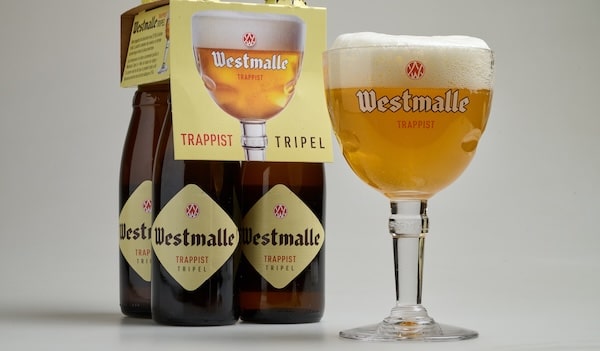
Abbey of Our Lady of the Sacred Heart, Westmalle. The brewery that defined the modern dubbel and tripel styles. Westmalle Dubbel (7% ABV) is the global template for the style; Westmalle Tripel (9.5% ABV) is one of the finest pale strong ales ever made. Both are widely distributed internationally and consistently excellent. This is the Trappist brewery most people should start with — the beers are exceptional and you can actually find them.
Chimay
Scourmont Abbey, Chimay. The most commercially distributed Trappist brewery in the world. Chimay produces three main beers: Red (Première, 7% ABV — a dubbel), White (Cinq Cents, 8% ABV — a tripel), and Blue (Grande Réserve, 9% ABV — a quadrupel). The Blue is the one to seek out: rich, dark fruit, warming, complex. All three come in both standard bottles and larger 75cl “corked and caged” bottles, which age remarkably well.
Rochefort
Abbey of Notre-Dame de Saint-Rémy, Rochefort. Three beers labeled by strength: Rochefort 6 (7.5% ABV), Rochefort 8 (9.2% ABV), and Rochefort 10 (11.3% ABV). The 10 is exceptional — dense, dark, and warming, with dark fruit, chocolate, and a richness that puts it in the same conversation as Westvleteren 12. Rochefort 8 is arguably more balanced and the best everyday-drinking option from the range. Distribution is wider than Westvleteren but still limited in some markets.
Orval
Abbey of Our Lady of Orval, Florenville. The outlier. Orval produces a single beer — Orval Trappist Ale (6.2% ABV) — that doesn’t fit neatly into any other style category. It starts life as a pale ale, is dry-hopped with whole hops, and then refermented in the bottle with wild Brettanomyces yeast — a process the Orval brewery describes in detail — which gradually transforms the beer over months and years. A young Orval is hoppy and fruity; a two-year-old Orval is funky, dry, and leathery. Cellar a case and open one each year to track the evolution. One of the most unique beers in the world.
Achel
Abbey of Saint Benedict, Achel. The smallest and youngest Belgian Trappist brewery, established in 1998. Achel lost its ATP status temporarily when the last brewing monk left the abbey in 2021 — brewing is now conducted by secular staff, though still under monastic agreement. Whether it retains full ATP recognition varies by current ITA decisions. The beers — particularly Achel Bruin Extra (9.5% ABV) — are excellent regardless of the label question.
Trappist Beer Styles: Dubbel, Tripel, Quadrupel
Most Trappist beers fall into one of three style categories, though breweries like Orval and some of the non-Belgian Trappist producers make beers that don’t fit any of them cleanly.
The dubbel is the dark, fruit-rich style — amber to brown, 6–8% ABV, built on Special B malt and dark candi sugar. Rich with raisin, plum, and caramel; yeast spice in the background. Westmalle Dubbel and Chimay Rouge are the primary examples. Our full Belgian dubbel guide covers this style in depth.
The tripel is pale, strong, and deceptively drinkable — typically 7.5–9.5% ABV, golden in color, dry, with intense yeast character: pepper, fruit, floral notes. Westmalle Tripel is the benchmark. Chimay White (Cinq Cents) is a close second. Both are stronger than they taste, which is either a feature or a warning depending on how your evening is going.
The quadrupel (or quad) is the highest-strength category — typically 10–12% ABV, very dark, intensely malt-forward with dried fruit, chocolate, and warming alcohol. Westvleteren 12, Rochefort 10, and Chimay Blue are the most celebrated examples. These are big beers meant for sipping slowly, ideally alongside food or a long conversation. If you want to explore the broader category of high alcohol beers, the Belgian quadrupel is a worthy place to start.
Trappist Breweries Beyond Belgium
The 14 recognized Trappist breweries extend well beyond Belgium’s borders. The Netherlands has two — La Trappe (Berkel-Enschot), the largest Trappist brewery in the world, with a full range of styles; and Zundert (Zundert Abbey), a smaller operation making a single blond ale. Both are excellent.
Austria contributes Stift Engelszell (Engelszell Abbey), making a range of ales including a distinctive Gregorius quadrupel at 10.5% ABV. Italy’s Tre Fontane Abbey produces Tre Fontane Tripel, unique for the eucalyptus leaves added during conditioning — a genuinely different flavor profile. England’s Tynt Meadow, from Mount Saint Bernard Abbey in Leicestershire, produces a single dark ale at 7.4% ABV, the first English Trappist beer since the medieval era. Spencer Brewery in Massachusetts produces the only American ATP beer. And Cardeña in Spain rounds out the current list.
Most of these non-Belgian ATP beers are difficult to find outside their home countries. If you encounter them while traveling, try them. They represent the Trappist tradition adapting to new locations with genuinely interesting results.
Frequently Asked Questions (FAQ)
What is the best Trappist beer in the world?
Westvleteren 12 consistently tops global beer rankings and is widely considered the finest example of the style — rich, dark, complex, and near-impossible to buy commercially. But “best” is genuinely subjective here. Rochefort 10 and St. Bernardus Prior 8 (not technically Trappist but brewed from the same heritage) rival Westvleteren 12 in blind tastings and are far easier to find. Westmalle Tripel is arguably the world’s best tripel. The honest answer is that several Trappist beers compete for the top position depending on the style and the taster.
How do you buy Westvleteren beer?
Westvleteren is only sold directly from Sint-Sixtus Abbey. To buy a case (maximum two cases per car, per visit), you call the abbey’s beer phone line, reserve a pickup date, and then drive to the monastery in West Flanders. You can also drink it at the café In de Vrede, across the road from the abbey, without a reservation. Some specialist beer importers occasionally get small allocations for restaurants and bottle shops — if you see it on a tap list or menu, order it. Don’t expect to find it at a supermarket. Ever.
Is Trappist beer stronger than regular beer?
Many Trappist beers are stronger than standard commercial lagers — quadrupels at 10–12% ABV and tripels at 8–9.5% are well above the typical 4–5% of everyday beer. But not all Trappist beers are high in alcohol. Orval is 6.2%, Westmalle Dubbel is 7%, and several non-Belgian Trappist breweries produce lower-ABV ales as their everyday beers. The range is wide. What Trappist beers tend to share isn’t strength but complexity — most are slow-fermented, bottle-conditioned, and built to reward attention.
What is the difference between Trappist and abbey beer?
Trappist beer carries the ATP seal and is brewed inside a Trappist monastery under monastic supervision. Abbey beer is a broader term covering beers brewed in a monastic style — including those with abbey names and branding like Leffe, Grimbergen, and Affligem — but without the ATP rules. Abbey beers can be excellent, but the label carries no legal guarantee about where they’re brewed or who oversees production. Some are brewed by major international breweries under license. The taste can be similar; the provenance is very different.
Can you visit Trappist breweries?
Some yes, some no. Chimay has a visitor center and café near the abbey and is the most tourist-accessible. Westmalle has a café adjacent to the abbey (In de Kluis) where you can drink the beers. Westvleteren’s café In de Vrede is open to visitors. Rochefort is not open to the public. Orval has a visitor museum at the ruins of the old abbey, and the café sells Orval on draft — it’s one of the most beautiful places in Belgium to drink a beer, and the pilgrimage is worth it for Trappist-curious travelers. Check each abbey’s current visitor policy before going; these change.
Join the Craft Beer Me Community
Trappist beer is one of the deepest rabbit holes in the beer world — once you start, you won’t stop. Sign up for the Craft Beer Me newsletter for regular guides to Belgian and world beer styles, brewery profiles, and homebrewing content. Come talk Trappist with fellow aficionados in the Craft Beer Me community — it’s free, and the Westvleteren stories alone are worth the price of admission.

What styles are your favorite? I’ve only tried a couple of Trappist beers but found them pretty unique.
Westvleteren 12 (pictured) is my favorite. It’s hard to get a hold of though because its traditionally only sold by the abbey. Rochefort 10 is also a good one to try and much easier to find.