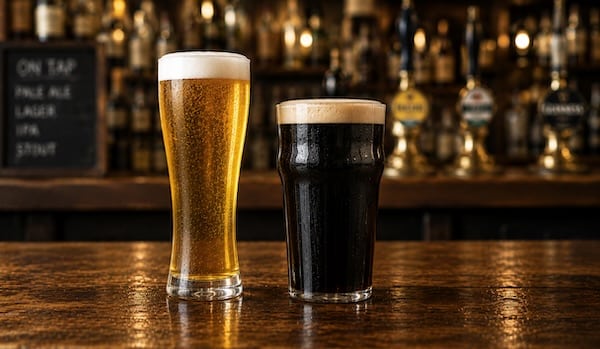

Pale ale vs IPA comes down to three things: bitterness, alcohol, and hop intensity. IPAs are bolder across the board — higher ABV (typically 6–7.5% versus the pale ale’s 4.5–5.5%), more aggressive bitterness, and more pronounced hop aromatics. Pale ales sit in the middle ground between mainstream lagers and full-strength IPAs — hop-forward enough to satisfy craft beer drinkers, restrained enough to drink more than two of them without reconsidering your life choices.
But that summary only works if you already know your way around a tap list. In practice, the line between pale ale and IPA has been blurring for the past decade, and some “pale ales” you’ll encounter are closer to an IPA in intensity than to a Budweiser. The classification matters less than knowing what you’re actually getting in the glass — and that’s what this guide covers.
The Core Differences: Pale Ale vs IPA
| Characteristic | Pale Ale | IPA |
|---|---|---|
| ABV range | 4.5–5.5% | 6.0–7.5% (standard) / 8–10%+ (Double IPA) |
| IBU (bitterness) | 25–45 | 40–70+ (West Coast) / 40–70 perceived (Hazy) |
| Hop aroma | Moderate — citrus, floral, pine | Intense — tropical, citrus, dank, resinous |
| Malt character | More balanced malt presence | Malt takes a back seat to hops |
| Body | Light to medium | Medium (Hazy can be fuller) |
| Drinkability | Sessionable — multiple in one sitting | More intense — one or two is the norm |
What Is a Pale Ale?
Pale ale is a broad category covering any ale brewed with pale malt — lighter in color and more hop-forward than traditional British ales, but more malt-balanced than an IPA. The American Pale Ale (APA) became the signature style of early US craft brewing, largely due to Sierra Nevada Pale Ale, which launched in 1981 and defined what an American pale ale tasted like for decades. CraftBeer.com’s history of the American Pale Ale documents how Sierra Nevada’s use of Cascade hops rewrote what American beer could taste like.
Sierra Nevada Pale Ale — still brewed with Cascade hops — is the benchmark. It’s citrusy, piney, slightly bitter, with a clean malt backbone that lets the hops show without overwhelming the beer. It’s the pale ale that most beer nerds point to when explaining the category. If you haven’t tried it, that’s where to start.
English pale ales are a different animal — rounder, maltier, with earthy and floral hop character from British hop varieties. If you order a “pale ale” at a British pub, you’re getting something noticeably different from an American craft pale. Both are legitimate, but they’re not the same drink.
Best Pale Ales to Try
- Sierra Nevada Pale Ale — the original American pale ale, still one of the best.
- Bell’s Two Hearted Ale — technically labeled an IPA but drinks more like a well-executed APA at 7%; a good bridge between the two categories.
- Firestone Walker Pale 31 — a classic West Coast APA that shows how the California brewing scene refined the style.
- Oskar Blues Dale’s Pale Ale — one of the first craft beers in a can and still a genuinely good pale.
What Is an IPA?
IPA stands for India Pale Ale — a name that originated in 19th-century Britain, where extra hops were used to help preserve beer on the long voyage to India. The historical accuracy of that story has been debated by beer historians, but the style it produced is real: a hop-forward ale with more bitterness and intensity than a standard pale ale. VinePair’s comparison of pale ale and IPA covers how the American craft beer movement pushed both styles further than their British origins suggested.
American craft brewing got hold of the IPA in the 1990s and pushed it to extremes the British original never approached. West Coast IPAs — resinous, bitter, pine and citrus forward, dry-finished — became the definitive American IPA style. Then New England IPAs (hazy IPAs) arrived and moved the focus from bitterness to aroma: soft, pillowy body, tropical fruit intensity, low perceived bitterness despite high IBU counts.
There are now so many IPA sub-styles that “IPA” alone doesn’t tell you much about what you’re actually getting. Knowing which sub-style you’re dealing with is more useful than knowing you’re ordering an IPA.
The Main IPA Sub-Styles
West Coast IPA — dry, bitter, resinous, clear. The classic American IPA. Stone IPA, Lagunitas IPA, and Ballast Point Sculpin are strong examples.
Hazy IPA (NEIPA) — soft, tropical, low bitterness, opaque. Tree House Julius, Trillium Congress Street, and Alchemist Heady Topper are the benchmarks, though regional hazy IPAs are everywhere now.
Session IPA — IPA flavor at a lower ABV (generally 3.5–5%), designed to drink more than one of. Founders All Day IPA is the most widely available example.
Double / Imperial IPA — everything turned up to 11: ABV 8–10%+, intense hops, significant malt backbone to balance the alcohol. Dogfish Head 90 Minute and Russian River Pliny the Elder are the celebrated examples.
Best IPAs to Try
- Stone IPA — the West Coast IPA benchmark: piney, bitter, aggressively hopped.
- Lagunitas IPA — a little maltier than Stone, West Coast style, nationally available and consistently good.
- Dogfish Head 60 Minute IPA — 60 hops added continuously over 60 minutes of boiling; complex, balanced, more accessible than many IPAs.
- Founders All Day IPA — the session IPA to try if you want IPA flavor without the 7% hit.
When to Choose Pale Ale vs IPA
The decision usually comes down to what you want from the experience. Pale ale is the right call when you want something hop-flavored but genuinely sessionable — a beer you can drink two or three of comfortably, at a meal, or alongside a long conversation. IPA is the right call when you want hop intensity to be the main event: the beer itself is the point, not just the backdrop.
If you’re new to craft beer and the bitterness of IPAs has been off-putting, pale ale is where to build your palate. Sierra Nevada Pale Ale and similar APAs give you the hop aromatics and character of craft beer at a bitterness level that’s actually approachable. Once the citrus and pine of Cascade hops stop reading as “bitter” and start reading as “flavor,” most people find the step up to a West Coast IPA much easier to make.
If you’re deciding between a hazy IPA and a pale ale, the line blurs further — modern hazy IPAs can have lower perceived bitterness than some pale ales, even at higher ABV. In that case, the body and tropical fruit intensity are better guides than the bitterness level.
Frequently Asked Questions (FAQ)
Is IPA stronger than pale ale?
Yes, in most cases. Standard IPAs typically run 6–7.5% ABV, while pale ales average 4.5–5.5%. The exception is Session IPAs, which are specifically designed to deliver IPA hop character at pale ale ABV levels (usually 3.5–5%). Double IPAs push even higher, often reaching 8–10% or above. If ABV matters to you, always check the label — the category names alone are not reliable guides to strength.
Is pale ale more bitter than IPA?
No — IPAs are generally more bitter, measured in IBUs (International Bitterness Units). A pale ale typically falls in the 25–45 IBU range; a West Coast IPA sits at 40–70+ IBUs. That said, perceived bitterness and measured bitterness don’t always match: Hazy IPAs often measure high in IBUs but are perceived as less bitter because the soft, hazy body and intense tropical aromas soften the bitterness impact. If bitterness bothers you, a hazy IPA might actually read as less bitter than a dry, crisp pale ale.
What’s the difference between pale ale and lager?
The fundamental difference is fermentation. Pale ales are ales — brewed with top-fermenting yeast at warmer temperatures, which produces a more complex, fruity, hop-forward character. Lagers are brewed with bottom-fermenting yeast at cold temperatures for a cleaner, crisper, less hoppy profile. Pale ales are also typically darker (golden to amber) compared to most lagers (straw yellow). For a deeper comparison, the dark lager guide shows what happens when those lager characteristics are pushed into darker malt territory.
What does IPA stand for?
IPA stands for India Pale Ale. The name comes from a historical story about British brewers adding extra hops to ale destined for soldiers and colonists in India in the early 19th century — the higher hop content acted as a preservative for the long sea journey. Whether the history is fully accurate has been debated, but the style name stuck, and the category it describes now covers dozens of sub-styles in the American craft beer market.
Which is easier to drink — pale ale or IPA?
Pale ale, in most cases. Lower ABV, more malt balance, and less aggressive hop bitterness make pale ales more approachable for casual drinking and more sessionable over the course of an evening. That said, hazy IPAs can be deceptively easy to drink — their soft body and low perceived bitterness make them go down quickly despite the higher alcohol content. If you’re pacing yourself, the ABV is a more reliable guide than the style category.
Join the Craft Beer Me Community
Hop heads, pale ale fans, and everyone still debating whether a Session IPA is really an IPA — come argue about it in the Craft Beer Me Facebook group. Sign up for the Craft Beer Me newsletter at the bottom of the page for new style guides and beer recommendations as they drop.
Sign Up for Our Newsletter