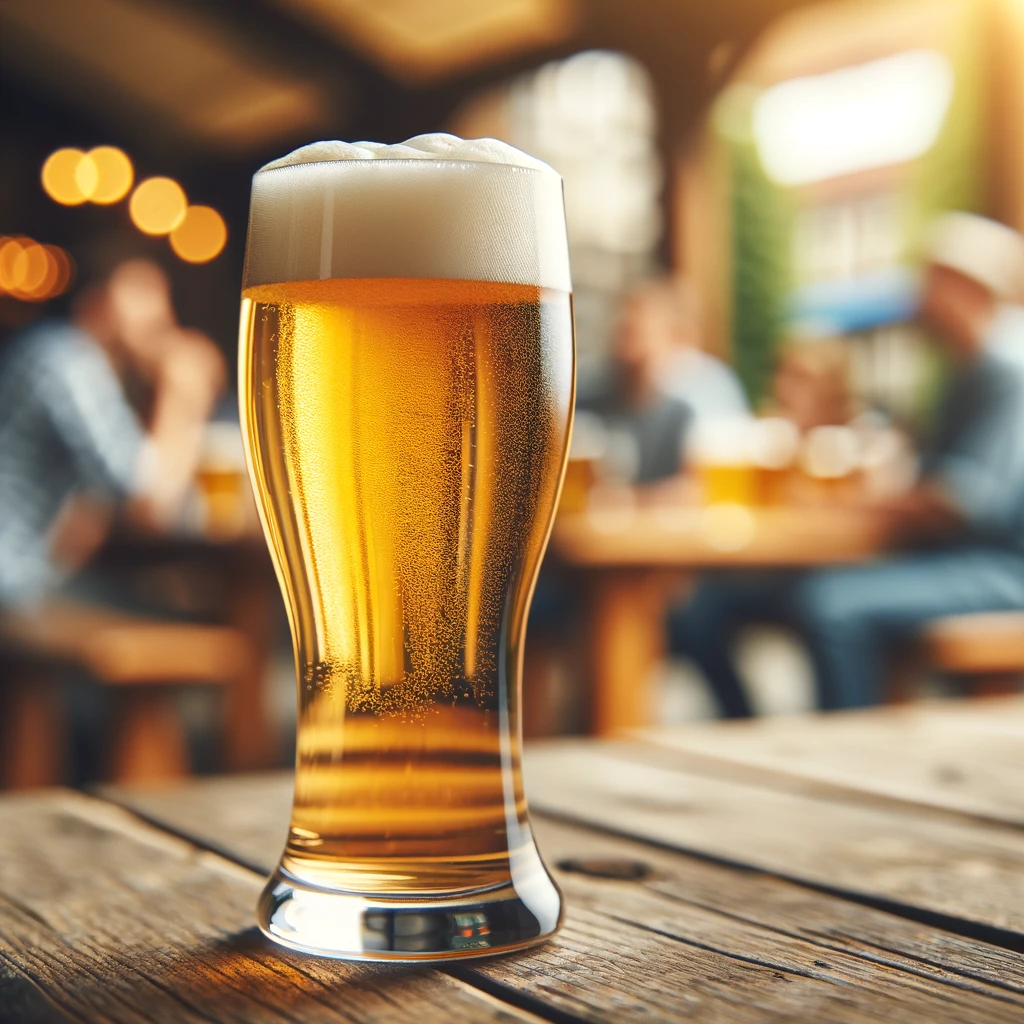
lager beer beer is made using the same basic process as ale — malting, mashing, boiling, fermenting, and conditioning — but with one critical difference: lager uses bottom-fermenting yeast at cold temperatures (35–50°F / 2–10°C) and then undergoes an extended cold conditioning period called lagering before packaging. This cold, slow process is what gives lager its clean, crisp, and smooth character that separates it from ale.
The word “lager” comes from the German word lagern, meaning “to store.” That storage phase — weeks or months of cold conditioning — is the defining step in lager production and the reason commercial lager brewing requires substantially more time, space, and refrigeration capacity than ale brewing. It’s also why lager dominated the commercial beer market once mechanical refrigeration became widely available in the late 1800s: scale made the economics work.
Here’s how it all works, from the grain to your glass.
Step 1: Malting — Preparing the Grain
Lager brewing starts with malted barley. Raw barley can’t be used directly in brewing because its starches aren’t accessible to water. Malting converts those starches into fermentable sugars by triggering germination — the grain is steeped in water, allowed to sprout, then dried in a kiln to stop the process.
The kilning temperature determines the malt type. Lightly kilned Pilsner malt produces pale, delicate beer with clean malt sweetness. More heavily kilned Vienna malt or Munich malt produces amber beer with toasty, bready character. Highly roasted malts (chocolate malt, black patent malt) produce dark beers like schwarzbier.
Most lager brewers don’t malt their own grain — they source from professional maltsters. But a handful of traditional Franconian breweries and some American craft producers still do their own malting, giving them total control over the character of their base ingredient.

Step 2: Mashing — Converting Starches to Sugar
Mashing is where the magic starts. The malted grain is crushed (the grist) and mixed with hot water in a vessel called a mash tun. The enzymes activated during malting get to work converting the grain’s starches into fermentable sugars. The brewer controls the temperature, time, and water-to-grain ratio to determine how much sugar is extracted and what kind of sugars are produced.
Traditional German lager brewers often use a technique called decoction mashing — a portion of the mash is removed, boiled separately, then returned to the main vessel. This raises the temperature in stages and develops a richer, more complex malt character. Modern craft brewers often skip decoction in favor of single-infusion mashing, which is simpler and produces clean results. The decoction method takes significantly longer but gives a depth of malt flavor that’s worth it for traditional styles.
After mashing, the liquid (called wort — pronounced “wert”) is separated from the spent grain and collected for the next step. Our guide to mashing in brewing covers this step in much more detail if you want to go deeper.

Step 3: Boiling and Hopping
The wort is transferred to a brew kettle and boiled for 60–90 minutes. This sterilizes the wort, concentrates it, and drives off unwanted volatile compounds. Hops are added during the boil at different intervals:
- Early additions (60 minutes before end): Hops added early undergo isomerization — their alpha acids convert into iso-alpha acids, which provide bitterness
- Late additions (final 10–15 minutes): Hops added late retain more aroma compounds, contributing floral or herbal scent
Lager hops are typically noble European varieties — Saaz, Hallertau, Tettnanger, Spalt. These have lower alpha acid content and more subtle flavor/aroma than the high-alpha American hops used in IPAs. The hop character in lager is restrained by design: background bitterness and a subtle herbal or spicy note rather than the assertive hop presence of an IPA.
After boiling, the wort is rapidly chilled before fermentation. Speed matters — the longer hot wort sits exposed to air, the greater the risk of contamination and unwanted oxidation.
Step 4: Cold Fermentation — What Makes Lager a Lager
This is where lager diverges fundamentally from ale. Lager yeast (Saccharomyces pastorianus) is pitched into cold wort — typically 45–52°F (7–11°C) — and fermentation proceeds slowly over one to two weeks. At these low temperatures, the yeast produces very few esters (the fruity flavor compounds common in ales) and virtually no fusel alcohols (the harsh higher alcohols that can cause headaches at warm fermentation temperatures).
The result is a clean, neutral fermentation character. The beer tastes primarily of malt and hops, not of the yeast that made it. This is lager’s defining characteristic — it’s a transparency that lets the ingredients speak clearly. A well-made lager is essentially nowhere to hide: if your malt quality is poor or your hops are stale, it shows. Our beer fermentation guide explains the full process and the chemistry behind it.
Lager yeast is also bottom-fermenting — it flocculates (clumps together and sinks) at the end of fermentation, settling to the bottom of the vessel rather than rising to the surface like ale yeast. This is where the term “bottom-fermenting” comes from, though the practical impact is mainly on how the yeast is harvested and repitched.
Step 5: Lagering — The Cold Conditioning Phase
After primary fermentation is complete, the beer enters the lagering phase — the step that gives the style its name and its character. The beer is transferred to conditioning tanks and held at near-freezing temperatures (32–38°F / 0–3°C) for an extended period. This cold rest accomplishes several things simultaneously.
The remaining yeast slowly cleans up diacetyl (a buttery off-flavor compound produced during fermentation) and other fermentation byproducts. Proteins and yeast flocs precipitate out of suspension, clarifying the beer naturally. Harsh compounds mellow, and the flavor integrates and smooths out. The CO2 from fermentation slowly dissolves into solution, creating the gentle, fine carbonation characteristic of lager.
How long does lagering take? Minimum four weeks for most styles. Traditional German lager brewers lager for two to three months, and bock beers can condition for six months or more. Commercial macro lager brewers use various techniques (artificial carbonation, centrifugation, accelerated conditioning tanks) to speed the process significantly — but the best craft lagers still take the time.
Step 6: Filtration and Packaging
After lagering, most commercial lagers are filtered — passed through fine filters to remove remaining yeast and protein, producing the brilliant clarity that defines the style visually. Some lagers (kellerbier, zwickelbier) are left unfiltered deliberately, preserving the haze and slightly fuller flavor.
Filtration is followed by pasteurization in most commercial operations — heat treatment that extends shelf life. Craft breweries often skip pasteurization (relying on cold chain distribution instead) to preserve fresher hop and malt character. Flash pasteurization (rapid, high-temperature, short-time treatment) is a compromise used by many mid-size craft brewers.
Finally, the beer is carbonated to the appropriate level and packaged in cans, bottles, or kegs. For kegs, natural conditioning from residual yeast may be used; for cans and bottles, forced carbonation is standard.
Why Lager Takes Longer to Make Than Ale
The short answer: every step runs slower at cold temperatures. Fermentation takes longer at 48°F than at 68°F. Conditioning requires weeks rather than days. Yeast flocculation and clarification happen more slowly. Cold slows everything down — which is exactly why the results taste different from a quickly-made warm-fermented ale.
A typical ale goes from grain to glass in 2–4 weeks. A traditional lager takes 6–12 weeks minimum. High-gravity bock beers can take six months. This is why small craft breweries often focus on ales — the faster turnaround time means more batches through the same equipment in the same time period, better economics. Dedicated lager breweries require more tank space and patient capital.
Frequently Asked Questions
What temperature is lager fermented at?
Lager fermentation typically occurs at 45–52°F (7–11°C) — significantly colder than ale fermentation, which usually runs 60–72°F (15–22°C). After primary fermentation, lager conditions (lagers) at near-freezing temperatures: 32–38°F (0–3°C) for weeks to months. The cold at every stage is what produces lager’s characteristic clean, crisp flavor profile.
How long does it take to make lager beer?
A typical lager takes 6–12 weeks from brewing to packaging — fermentation runs 1–2 weeks, followed by 4–10 weeks of cold conditioning (lagering). Traditional German lagers and bock beers can take three to six months. Mass-market commercial lagers use accelerated conditioning methods to shorten this timeline significantly, but premium craft lagers still take the full time.
What is the difference between lager yeast and ale yeast?
Lager yeast (Saccharomyces pastorianus) ferments at cold temperatures and sinks to the bottom of the vessel when done — it’s “bottom-fermenting.” Ale yeast (Saccharomyces cerevisiae) ferments warmer and rises to the top — “top-fermenting.” Lager yeast produces very few esters and off-flavors at cold temperatures, giving beer a clean character. Ale yeast produces more complex flavor compounds including fruity esters.
What does lagering mean in brewing?
Lagering is the cold conditioning phase of lager production — holding the finished beer at near-freezing temperatures for an extended period after primary fermentation. During lagering, residual yeast cleans up off-flavors, proteins precipitate out to clarify the beer, and the flavor integrates and mellows. The word comes from the German lagern, meaning “to store.” This phase is what gives lager its characteristic smooth, clean finish.
Join the Craft Beer Me Community
Want to learn more about how beer is made or explore home brewing? Sign up for the Craft Beer Me newsletter for guides, recipes, and more.